# Cash Register Counting App: Why Denomination-Level Tracking Beats Lump Sums
Every business that handles cash faces the same silent question at the end of each shift: does the drawer balance? For most, the answer is a shrug and a lump-sum figure scribbled on a slip. That approach might feel fast, but it hides the very problems you need to see. A modern cash register counting app changes the equation entirely — by recording every denomination, every handoff, and every deposit with a level of detail that lump-sum counting simply cannot match.
Whether you run a café in Amsterdam, a pharmacy in Athens, or a hotel front desk in Lisbon, the principle is the same: if you cannot prove the handoff, you do not control the cash. This article explains why denomination-level cash counting is the new standard, how it protects your revenue, and what to look for when choosing the right tool.
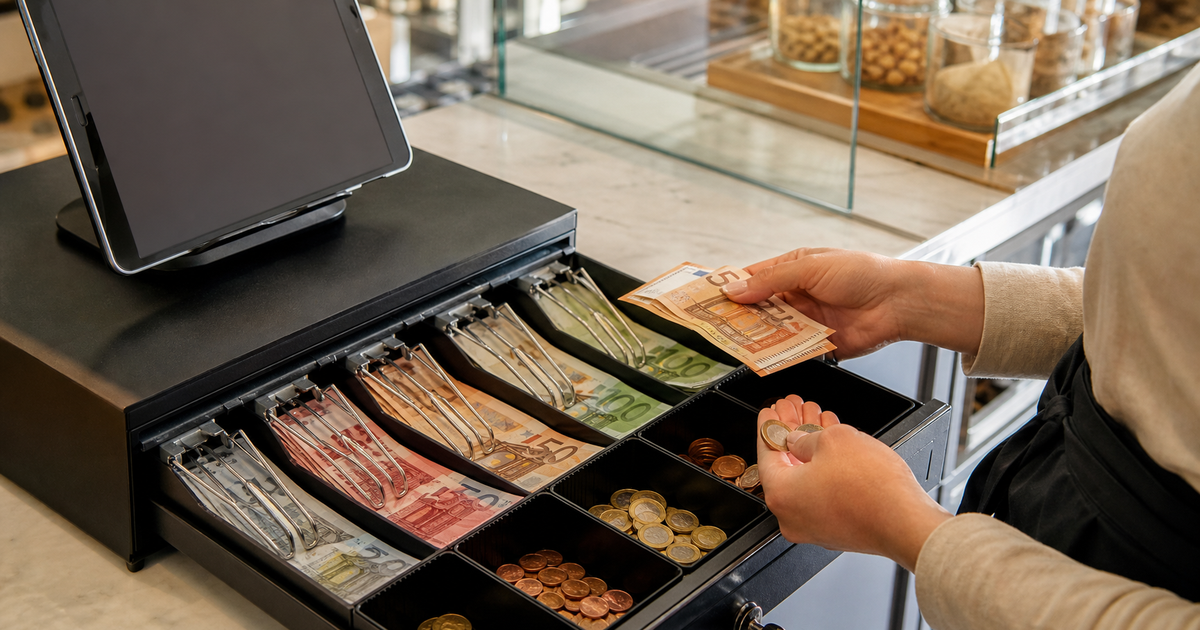
!Retail cashier counting cash at a register in a busy shop
The Problem with Lump-Sum Cash Counting
Lump-sum counting means opening the register, counting the total, and writing down a single number. It is the method most small businesses still use — and it is the method most vulnerable to error and fraud.
No Visibility into Composition
A drawer that shows €500 could contain fifty €10 notes or five €100 notes. The total is identical, but the composition tells a completely different story. Without knowing the denomination breakdown, you cannot detect whether someone swapped large notes for small ones, pocketed the difference, and left the total looking correct.
No Audit Trail Between Shifts
When Shift A ends and Shift B begins, a lump-sum count creates a single data point with no context. If a discrepancy surfaces hours later, there is no way to determine which shift — or which employee — was responsible.
Shrinkage Hides in Plain Sight
According to the National Retail Federation, inventory shrinkage cost U.S. retailers over $112 billion in recent years. Cash shrinkage is a significant slice of that figure, and lump-sum counting is one of the primary reasons it goes undetected. European retailers face similar challenges, with the problem magnified wherever cash remains the dominant payment method.
What Is Denomination-Level Counting in a Cash Register Counting App?
Cash denomination counting means recording the exact number of each coin and note in the drawer — not just the total. A proper cash register counting app guides the user through every denomination step by step, calculates the total automatically, and timestamps the result.How It Works in Practice
1. The cashier opens the counting screen on a tablet or phone.
2. They enter the quantity of each denomination: €0.01, €0.02, €0.05 … all the way up to €100, €200, and €500.
3. The app calculates the grand total instantly.
4. The count is saved with the employee name, shift ID, timestamp, and location.
This structured approach turns a vague number into a forensic-grade record. If the €20 stack is short by three notes, you know exactly where to look — and exactly who was responsible for that drawer.
Five Reasons Denomination Tracking Outperforms Lump Sums
1. Pinpoint Discrepancies Instantly
When every denomination is logged, a €60 shortage is not a mystery — it is three missing €20 notes. Managers can investigate the specific denomination rather than chasing a vague total across an entire shift.
2. Deter Internal Theft
Employees who know that every note is tracked behave differently from those who know only the total is checked. Denomination-level counting raises the perceived risk of detection, which is one of the most effective deterrents against opportunistic theft. The psychology is simple: people take fewer risks when they know the details are recorded.
3. Simplify Bank Deposits
Preparing a bank deposit is faster when you already have an accurate denomination breakdown. No recounting at the back office. No surprises at the teller window. Just print the summary and go.
4. Build a Chain of Custody
Cash changes hands multiple times: from customer to cashier, from cashier to shift manager, from manager to safe, from safe to bank. Each handoff is a potential point of failure. A cash register counting app with denomination tracking creates an unbroken record at every step — aligned with what Eurocommerce calls "operational traceability" in its retail best-practice guidelines.
5. Generate Anomaly Alerts Automatically
Patterns that a human eye would miss — a consistent shortage of €50 notes on Tuesday evenings, for example — become visible when data is structured. Advanced tools use these patterns to trigger anomaly alerts, flagging irregularities before they become costly trends.
The Chain-of-Custody Gap Most Businesses Ignore
Most cash losses do not happen at the register. They happen between the register and the bank.
A cashier counts the drawer correctly. The shift manager seals the cash in an envelope. The envelope sits in a safe overnight. Someone takes it to the bank in the morning. At any point along this chain, cash can disappear — and without proof of each handoff, no one can be held accountable.
QR-Tracked Envelopes and Approval Codes
The solution is surprisingly simple: assign every cash envelope a unique QR code and require a unique approval code at each handoff. When the cashier seals the envelope, they scan the QR code and enter their approval code. When the manager receives it, they do the same. When it reaches the bank, the chain is complete.
This is the principle behind CashProof's deposit chain-of-custody feature. Every touch point is logged, every handoff is verified, and every discrepancy can be traced to a specific moment and person. It turns "I thought I gave it to you" into a timestamped, code-verified fact.
If you cannot prove the handoff, you do not control the cash.What to Look for in a Cash Register Counting App
Not every counting tool is built for accountability. When evaluating a cash register counting app, look for these non-negotiable features:
Denomination-by-Denomination Entry
The app should walk the user through every coin and note, not offer a single "total" field. This is the foundation of accurate cash denomination counting.
Unique Approval Codes per Employee
Generic logins are not enough. Each team member should have a unique code that ties every action to their identity — eliminating the "it wasn't me" defence.
QR-Tracked Deposits
Paper envelopes are fine — as long as they carry a scannable code that links them to the digital record and creates a verifiable chain of custody.
Anomaly Alerts
The system should flag unusual patterns automatically: unexpected shortages, denomination imbalances, or counts that fall outside historical norms.
Multi-Location Support
If you operate more than one site, you need a single dashboard that shows every location's cash status in real time.
CashProof was built specifically for these requirements. It combines denomination-level counting with QR-tracked envelopes, unique approval codes, and real-time anomaly alerts in a single platform designed for retail, hospitality, and service businesses across Europe. See how it works.Frequently Asked Questions
Q: Is a cash register counting app difficult for staff to learn?A: No. Most denomination-counting apps are designed for speed and simplicity. A typical end-of-shift count takes under two minutes once staff are familiar with the interface. The step-by-step denomination flow is actually faster than manual recounting because the app handles all the arithmetic automatically.
Q: Can denomination tracking work for businesses that also accept card payments?A: Absolutely. Cash denomination counting focuses specifically on the physical cash in the drawer. Card transactions are handled by your POS system. The two complement each other — the POS tracks digital payments, while the counting app tracks physical cash with full accountability.
Q: How does CashProof handle multiple shifts per day?A: Each shift gets its own count, timestamp, and unique approval code. When one shift ends and another begins, both employees verify the drawer count independently. This creates a clear boundary of accountability between shifts, so discrepancies can always be traced to the right window of time.
Take Control of Every Note and Coin
Cash is not disappearing from business — it is simply getting harder to manage without the right tools. Denomination-level counting, chain-of-custody tracking, and automated anomaly detection are no longer luxuries reserved for large retailers. They are accessible to every café, pharmacy, and hotel that wants to stop guessing and start proving.
The shift from lump-sum counting to structured, denomination-level tracking is the single most impactful change a cash-handling business can make. Start with a free trial and see the difference in your very first shift count.
For more insights on cash management and operational accountability, visit our blog.
Συχνές Ερωτήσεις
Πού μπορώ να βρω περισσότερες πληροφορίες;
Για περισσότερες πληροφορίες επισκεφθείτε τον ιστότοπό μας ή επικοινωνήστε μαζί μας.
Ποια είναι τα βασικά οφέλη;
Τα βασικά οφέλη περιλαμβάνουν ποιότητα, αξιοπιστία και εξυπηρέτηση.
Πώς ξεκινάω;
Ξεκινήστε εγγράφοντας στον ιστότοπό μας για δωρεάν πρόσβαση.